
Fascia: The Architecture of Youthful Skin
When we speak about ageing, the focus often remains on the surface. Fine lines. Pigmentation. Texture.
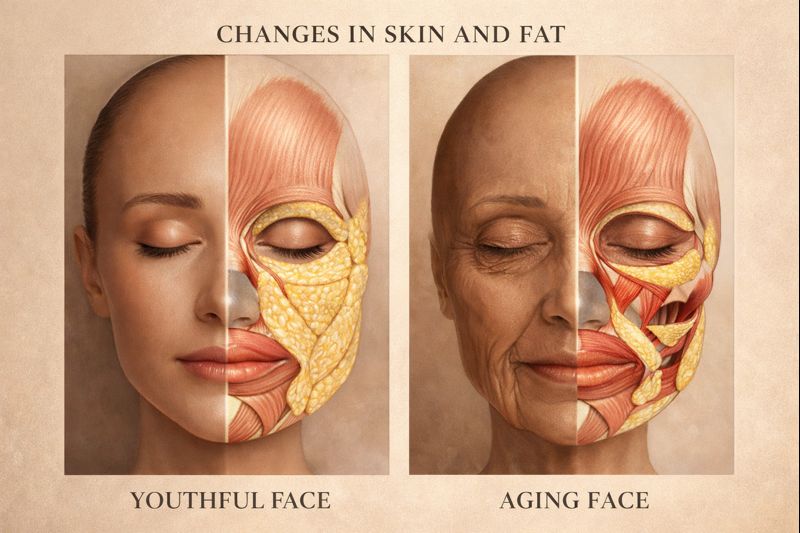
Yet structural ageing begins deeper. Beneath the skin lies fascia, a continuous web of connective tissue that supports muscles, vessels and facial contours. It is the framework that influences lift, balance and definition.
Healthy fascia is hydrated and supple. It allows tissue to glide with ease, maintaining clarity through the jawline and elevation through the mid-face.
When restricted or dehydrated, tissue begins to descend. Puffiness lingers. Contour softens.
At Skin Sanctum, we do not look only at the skin. We consider the architecture beneath it. Fascia is that foundation.
The Living Web of Connective Intelligence
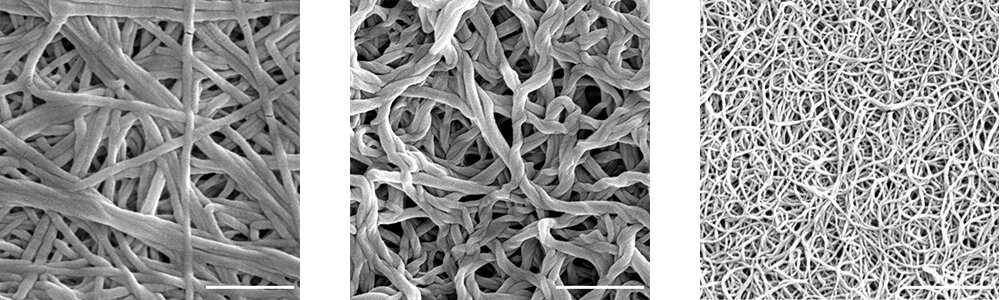
Fascia is a three dimensional network of connective tissue that extends throughout the entire body. It surrounds and interweaves with muscles, nerves and blood vessels, creating continuity rather than separation between structures.
In the face, fascia works closely with the superficial muscular system, forming part of the structural matrix that influences how the skin drapes and moves. It is not simply a wrapping. It is a living, responsive tissue that adapts to pressure, posture, stress and hydration.
When functioning optimally, fascia remains elastic and well hydrated. Its fibres glide smoothly, allowing expression without strain and maintaining balanced tension across the facial planes.
When compromised, this glide diminishes. Tissue can feel dense or restricted, and subtle imbalances begin to appear in contour and symmetry.
Understanding fascia shifts the perspective of ageing. It reminds us that beneath the visible surface lies a dynamic system requiring both care and respect.
How the Fascia system works
Fascia functions as a dynamic support system, distributing mechanical tension across the face and maintaining coherence between muscles and skin. It responds continuously to movement, expression and posture, adapting to the forces placed upon it. Over time, repetitive patterns such as jaw clenching, screen posture or sustained stress can influence how this network organises itself, subtly shaping contour and balance.
Its integrity is closely linked to hydration and collagen quality. Well hydrated fascia maintains suppleness and elasticity, allowing tissues to move with fluid precision. When hydration declines or collagen weakens, resilience reduces and the architecture begins to lose its refinement. Structural ageing is therefore not sudden, but the result of gradual shifts within this intelligent connective framework.
Fascia and the Lymphatic System
Fascia and the lymphatic system are often spoken about interchangeably, yet they serve different roles within facial health. Fascia provides structural support and tension distribution, influencing contour and lift. The lymphatic system, by contrast, is responsible for fluid transport, clearing metabolic waste and reducing excess interstitial fluid that contributes to puffiness and stagnation. One governs structure. The other governs flow.
Although distinct, they are deeply interconnected. Lymphatic vessels travel within fascial pathways, meaning restriction within connective tissue can impair fluid movement. Equally, congestion within the lymphatic system can create heaviness that alters tissue tone. For refined and lasting results, both architecture and drainage must be addressed in harmony.
Fascia and Ageing
Structural Change Beneath the Surface
Ageing is often described in terms of wrinkles and pigmentation, yet the more profound shifts occur within the structural layers beneath the skin. As collagen production declines and hormonal changes influence tissue resilience, fascial elasticity gradually reduces. The once supple network becomes less responsive, contributing to subtle descent through the mid face and a softening of the jawline.
These changes are not abrupt. They reflect cumulative tension, reduced glide and diminished connective strength over time. When fascia loses adaptability, contour appears heavier and lines become more established. Understanding this progression reframes ageing as a structural evolution, not simply a surface concern.